
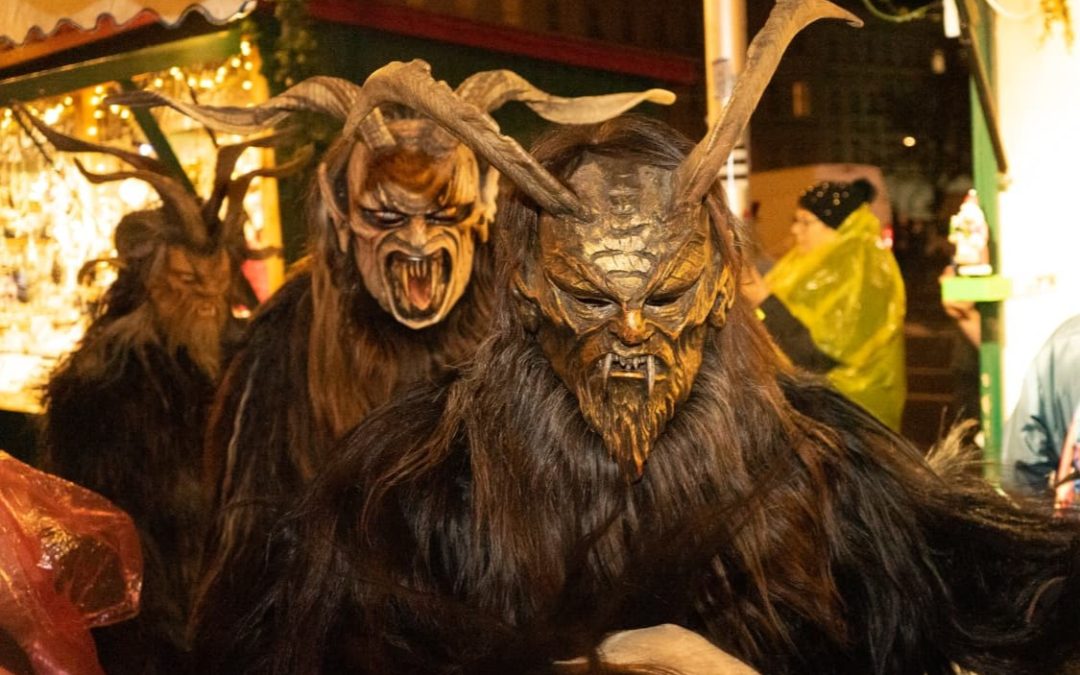
Zirbe (Swiss stone pine), billy-goat horns, a beard of goat hair: a genuine Krampus mask is handwork that a carver spends many hours on. Krampus – a horned, fur-clad figure from Alpine folklore who accompanies St. Nicholas – comes to our Salzburg Christmas market at Mirabellplatz (Mirabell Square) on Thursday 3 December 2026: from 6 pm the Alt Gnigler run here, and you can see Larven like these up close (Larve – the carved wooden mask, as it’s called in Salzburg). Here’s what a Krampus mask is made of, how it’s made and how to look at one respectfully.
What is a Krampus mask? A Krampus mask, often called a “Larve” in Salzburg, is a hand-carved wooden mask with animal horns, inset eyes and fur or hair. Krampus figures wear it in Advent, and Schiachperchten (“ugly” Perchten – Perchten are fur-clad, masked figures from Alpine winter folklore) wear it in the Rauhnächte, the “rough nights” of midwinter.
When the Alt Gnigler run at our market is further down.
What is a Krampus mask made of?
A traditional Krampus mask is made of wood, horns, fur and paint. The wood is mainly Zirbe; Salzburg carvers also use Weymouth pine and lime. Both kinds of pine are soft, but carving still takes strength and care so that the wood doesn’t crack.
- Wood: Zirbe, Weymouth pine or lime. According to the SalzburgerLand Magazin, the carver Rupert Kreuzer from Großarl works mainly with Zirbe.
- Horns: usually from billy goats, rams, ibex or chamois. There are also horns made of plastic.
- Fur and hair: for beard, mane and suit, usually from goats and sheep. The Alt Gnigler describe their first masks from 1966 as decorated with horse, goat and sheep hair.
- Eyes and paint: The eyes are set in, and then the mask is painted.
According to Salzburg24, the “Krampus-Knigge” (Krampus etiquette guide) of the Anifer Krampusse, a Krampus group from Anif, names a hand-carved wooden mask and goat or sheep furs as the marks of a good Krampus. By this advice, masks made of rubber or plastic don’t belong.
How a Larve is made: from a block of Swiss stone pine to a mask
A carved Krampus mask is made in several steps and takes many hours. In 2013, a Salzburg mask carver told Salzburg24 that a Larve takes around 30 hours. From a 40-centimetre section of trunk he carved four masks.
The Faistenau carver Bernhard Reiter describes how the work goes in the SalzburgerLand Magazin:
- With a chainsaw he cuts the rough profile out of the block of wood.
- With a pencil he sketches the facial features.
- With knife and mallet he carves out the shape.
- Then come the fine details: wrinkles, expression, beard.
- Finally he sets in the eyes, mounts the horns and paints the mask.
Reiter leaves out too much blood: the zombie look, he says, has little to do with tradition. According to Salzburg24, the classic “Postkartenkrampus” (postcard Krampus) with tongue, long ears and a bigger nose is in demand again in Salzburg, along with heavier furs and bigger horns. The Gastein masks, with dark colours and several horns, are considered particularly traditional.
How heavy is a Krampus mask?
With real animal horns, a Krampus mask can weigh up to 13 kilos (about 29 lb), according to Salzburg24. The horns, the carver says, have a big influence on the weight. During a run, the fur suit and the bells come on top.
The runner carries the whole weight on head and neck. That’s why you never grab a Krampus by the horns: according to the “Krampus-Knigge”, there’s a serious risk of neck injury. What else to bear in mind as a spectator is in our tips for the Krampus run.
Schiachperchten Larve and Schönperchten Kappe
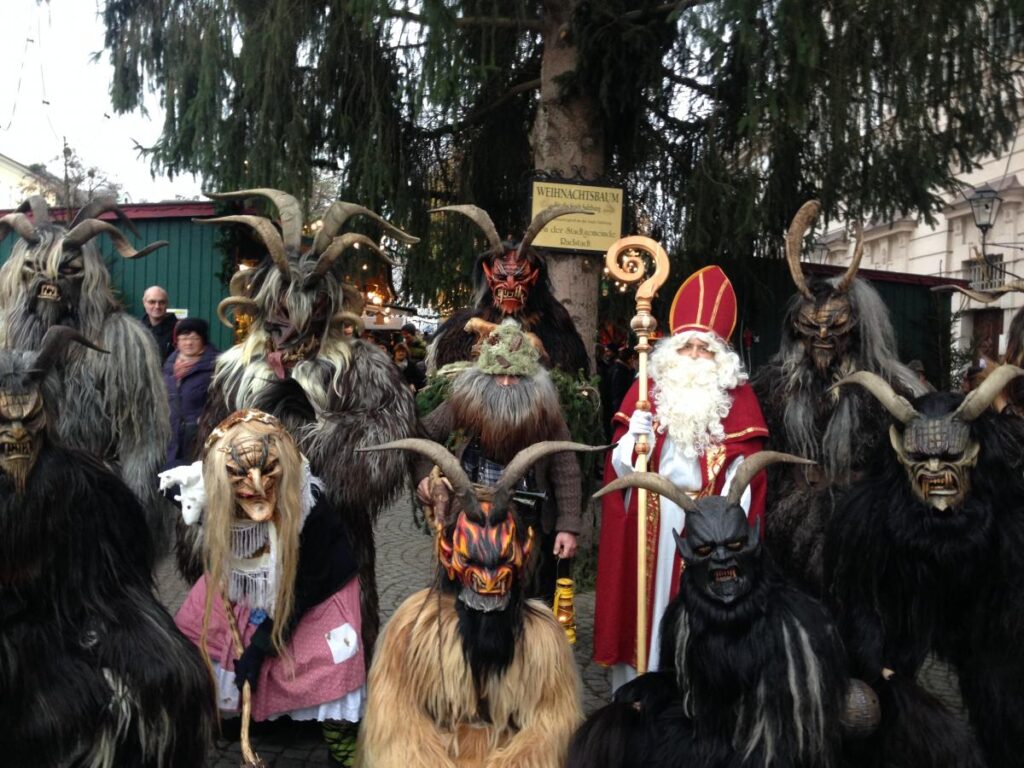
Perchten masks don’t all look the same, because there are two quite different groups. The Schiachperchten, the “ugly” Perchten, wear wooden Larven with horns and dark fur, similar to a Krampus. Instead of a Larve, the Schönperchten (“beautiful” Perchten) wear a Kappe – the tall, decorated headdress of the Schönperchten.
| Schiachperchten Larve | Schönperchten Kappe | |
|---|---|---|
| Form | carved wooden mask in front of the face | tall headdress on top of the head |
| Material | wood, horns, fur and hair | structure with decorations, boards, feathers or ribbons |
| Effect | wild, dark, loud | festive, colourful |
| Example in Salzburg | Schiachperchten of the Alt Gnigler with six horns | Kappen of the Gastein Perchten, up to 50 kilos |
According to their website, the Alt Gnigler’s Schiachperchten wear six horns: two pairs from billy goats and one pair from a ram. Among the Schönperchten, every region is different. The Pongau Tafelperchten wear tall Kappen topped with decorated, often colourful boards; the Tresterer (Percht dancers of the Pinzgau) in Zell am See wear a crown of white cockerel feathers. According to Gasteinertal Tourismus, a Kappe of the Gastein Perchten weighs up to 50 kilos (about 110 lb), and around 30 Kappe wearers take part. The Gastein Perchten run takes place every four years and has been on Austria’s national inventory of intangible cultural heritage since 2011.
Wooden masks, by the way, are younger than many people think. According to Michael Greger of the Salzburger Landesinstitut für Volkskunde (Salzburg Institute of Folklore), disguises in the 17th and 18th centuries were often simple, sometimes just scraps of cloth with eye holes. Wooden masks only appeared in the later 18th century. How Krampus and Percht are connected is explained in our article Krampus or Percht?.
Bells and chains
A Larve goes hand in hand with sound. Bells, jingle bells and chains make the noise that tells you a Krampus run is coming before you see it. In 1966 the first Alt Gnigler ran through Gnigl with cowbells, rattling chains and switches of birch and willow. Today a blacksmith in the association makes some of the group’s bells himself.
Mask carvers in Salzburg and the masks of the Alt Gnigler
Behind every Larve is a carver with his own signature style. Rupert Kreuzer carves in Großarl in the Pongau, Bernhard Reiter in Faistenau in the Flachgau. According to the SalzburgerLand Magazin, Reiter used to run as a Krampus himself and now carves for Passen (local Krampus and Perchten groups) from the region.
You can follow this well with the Alt Gnigler Krampus Perchten Pass from the Salzburg district of Gnigl. According to the association’s history, the founders made their first masks themselves in 1966, from fur and papier-mâché, and got the cow horns from the butcher. In 1972, for the first Gnigler Krampuslauf (the Gnigl Krampus run), the first carved wooden masks appeared. For a good thirty years, most of the masks have come from Wolfgang Gangl, a mask carver from the Pongau. Every mask is a one-off; together the members own more than 140 masks, including old Gastein Larven. The fur suits of goatskin and sheepskin come from a tannery in St. Johann im Pongau.
In 2016, for their 50th anniversary, the Alt Gnigler showed more than 140 masks in an exhibition in Salzburg’s Zwergerlgarten (Dwarf Garden).
Looking at and photographing a Krampus mask respectfully
There’s a person under every mask, and the mask itself is often many hours of handwork. If you want to see a Larve up close, our tips will help:
- Ask first, then look. Speak to the runner, ideally at the edge or when the group stops.
- Don’t touch without permission. Above all, don’t pull on horns, beard or fur.
- Take photos without flash. The runner can’t see much through the eye holes anyway, and a flash from close up dazzles him.
- Keep your distance. Don’t step into the group’s path just because you want a better photo.
On Thursday 3 December 2026, from 6 pm, the Alt Gnigler run at our market at Mirabellplatz. It’s a Krampus run with St. Nicholas: only Krampus figures run, as the group doesn’t show its Perchten until the Rauhnächte, and St. Nicholas hands out sweets to the children. What to expect that evening is in our article on the Krampus run at Mirabellplatz.
Christmas programme
On Thursday 3 December 2026, from 6 pm, the Alt Gnigler run at our market at Mirabellplatz with masks, fur and bells, and St. Nicholas comes too. All dates are in the programme.
Frequently asked questions
Mainly Zirbe (Swiss stone pine). Salzburg carvers also use Weymouth pine and lime. These woods are soft, but you still have to take care when carving that they don’t crack.
With real animal horns, a Krampus mask can weigh up to 13 kilos, according to Salzburg24. Exactly how heavy depends mainly on the horns. According to Gasteinertal Tourismus, the Kappe of a Gastein Schönpercht weighs as much as 50 kilos.
Around 30 hours for a Larve, a Salzburg mask carver told Salzburg24. According to the SalzburgerLand Magazin, the exact figure is hard to pin down, because every mask is a one-off.
A Schiachperchten Larve often looks similar to a Krampus mask: wood, horns, fur. The difference lies mainly in the custom and the time of year, because Krampus comes in Advent and the Perchten in the Rauhnächte. Schönperchten wear a tall, decorated Kappe instead of a Larve.
Only if the runner allows it. It’s best to ask at the edge or after the run. Never pull on the horns: that can injure the runner’s neck.
At the Krampus runs in Advent, for example on Thursday 3 December 2026, from 6 pm, at our market at Mirabellplatz with the Alt Gnigler. More runs and dates in the city are in our article on Krampus in Salzburg.
Sources
Retrieved on 2 November 2026: Alt Gnigler Krampus Perchten Pass, website: home page, history, association, 50 years · SalzburgerLand Magazin: Carving Krampus masks · SalzburgerLand Magazin: Shaggy dark figures with billy-goat horns · Salzburg24: A Krampus mask carver gives an insight (29 October 2013) · Salzburg24: Traditional Krampus masks in demand again (31 October 2024) · Salzburg24: Krampus-Knigge (5 November 2024) · Salzburg24: Perchten in Salzburg (12 December 2024) · Gasteinertal Tourismus: press release on the Gastein Perchten run · Austrian Commission for UNESCO: “Perchten” in Gastein