
When the brass players strike up in front of the palace at Mirabellplatz and the lights come on on the Christmas tree, Advent has arrived in Salzburg. Austria has many Christmas traditions of its own, from St. Barbara’s branches (Barbarazweige) and Krampus – a horned, fur-clad figure from Alpine folklore who accompanies St. Nicholas – to the Christkind (Christ Child, who brings the presents in Austria). We’ve gathered the most important Austrian Christmas traditions and noted where you can experience them in Salzburg in 2026, some of them with us at the Salzburg Christmas market at Mirabellplatz.
What are typical Austrian Christmas traditions? The best-known Christmas traditions in Austria include the Advent wreath, St. Barbara’s branches on 4 December, St. Nicholas and Krampus, Adventsingen (Advent singing – an evening of folk music, singing and a shepherds’ play before Christmas) and Turmblasen (brass music played from the city’s towers), the Christkind as the bringer of presents, burning incense (Räuchern) during the Rauhnächte (the “rough nights” between the winter solstice and Epiphany) and the Sternsinger (star singers, carol singers at Epiphany).
Our Advent dates are further down.
Austrian Christmas traditions: the calendar from Advent to Epiphany
| When | Tradition | Experience it in Salzburg in 2026 |
|---|---|---|
| from 29 November | Advent wreath | a tradition at home; at our market the lights on the Christmas tree come on as early as Wed 25 November at 6 pm |
| from 19 November | Turmblasen and Advent music | Turmblasen on Residenzplatz from 19 November, Advent music in front of Schloss Mirabell (Mirabell Palace) from 21 November, mostly at 5.15 pm |
| from 27 November | Adventsingen | Festspielhaus (Festival Hall) and St. Andrew’s Church (Andräkirche) at Mirabellplatz |
| 4 December | St. Barbara’s branches | a tradition at home |
| 5 and 6 December | St. Nicholas and Krampus | St. Nicholas and Krampus at Mirabellplatz, Wed 2 December, 6 pm |
| Advent | Nativity scenes | nativity scenes in churches, for example in St. Andrew’s Church |
| 24 December | Christkind, Silent Night, Midnight Mass | memorial service in Oberndorf at 5 pm, Midnight Mass in the cathedral |
| 21 December to 6 January | Rauhnächte, burning incense, Perchten (fur-clad, masked figures from Alpine winter folklore) | Perchten run on Domplatz, Mon 21 December |
| 31 December | New Year’s Eve and wax pouring | our last market day, 10 am to 7 pm |
| 5 and 6 January 2027 | Glöckler (bell-ringers with illuminated headdresses) and Sternsinger | Sternsinger go from house to house |
Dates of other organisers (Turmblasen, Adventsingen, Oberndorf, Midnight Mass, Perchten run): according to the organisers or Salzburg Tourism, as of October 2026. Details and sources are in the sections below.
Advent: Advent wreath, tree-lighting and brass music
The Advent wreath came from northern Germany, where Johann Hinrich Wichern invented it in Hamburg in 1839. According to Kathpress, it only became firmly established in Austria after 1945. On each Sunday in Advent one more candle is lit; in 2026, Advent begins on 29 November.
At our market at Mirabellplatz, the lights on the big Christmas tree come on on Wednesday 25 November 2026 at 6 pm. From 21 November, Advent music is played in front of Schloss Mirabell on 20 days, mostly at 5.15 pm. There’s more about this and about the Turmblasen in the Old Town in our article on Turmblasen and Advent music. Adventsingen is a Salzburg tradition of its own; the Salzburger Adventsingen was first held in 1946. Everything about it is in our article on Adventsingen in Salzburg.
Christmas programme
Tree-lighting on 25 November, St. Nicholas and Krampus on 2 December and Advent music in front of the palace: all our 2026 dates at Mirabellplatz are in the programme.
St. Barbara’s branches, St. Nicholas and Krampus: 4 to 6 December
On 4 December, St. Barbara’s Day, people in Austria cut branches from cherry or other fruit trees and put them in a vase. If they blossom by Christmas, it’s seen as a good sign for the coming year.
Two days later, on 6 December, is St. Nicholas Day. On the evening before, Krampusnacht, the Krampusse set out – St. Nicholas’s wild companions. At our market at Mirabellplatz, St. Nicholas and Krampus come on Wednesday 2 December 2026 at 6 pm. When else Krampusse roam the city is in our article on Krampus in Salzburg.
Nativity scenes in Salzburg: where to see them in Advent
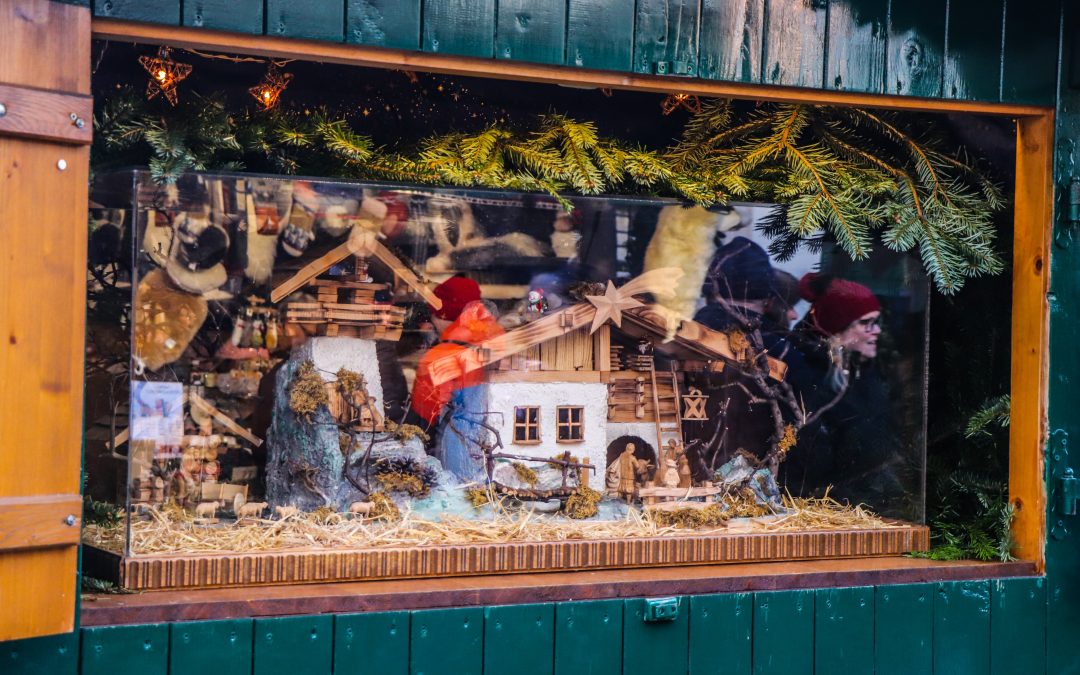
The nativity scene with Mary, Joseph and the child in the stable is as much a part of Christmas in Austria as the Christmas tree. In Salzburg, according to Salzburg Tourism, you can see nativity scenes in places including St. Andrew’s Church at Mirabellplatz, where one stands all year round, and in the cathedral. If you’d like to buy a nativity scene or figures yourself, you’ll find them at our market at Tanja Konrad’s and Gordon Buller’s stalls. There’s more in our article on souvenirs from Salzburg.
The Christkind, not Santa: who brings the presents in Austria
In Austria, it’s the Christkind who brings the presents, not Santa Claus (Father Christmas). In a non-representative survey of 1,500 users by the platform willhaben in 2018, around 60 per cent said the Christkind brought the presents in their home; just over 3 per cent named Santa Claus. Presents are given on the evening of 24 December, often announced by the ringing of a little bell.
24 December: Christmas Eve in Salzburg
Christmas Eve has several traditions of its own in Salzburg:
- Christkindlanschießen (ceremonial shots to welcome the Christ Child): according to Salzburg24, the Festungs-Prangerstutzenschützen, a company of traditional ceremonial gunners, fire from Hohensalzburg Fortress shortly after noon on 24 December.
- Silent Night: in Oberndorf, where the carol “Stille Nacht” was first heard in 1818, there’s a memorial service every year on 24 December at 5 pm, according to SalzburgerLand Tourism (as of October 2026). There’s more in our article on the Christmas markets after Christmas.
- Midnight Mass: according to Salzburg Tourism, Midnight Mass (Christmette) in Salzburg Cathedral begins at 11.30 pm on 24 December 2026 with Mozart’s Organ Solo Mass; carols are sung from 11 pm.
At our market at Mirabellplatz, you’ve got time for one last visit before the presents on 24 December, from 10 am to 3 pm. How to plan the whole day is in Christmas Eve in Salzburg.
Rauhnächte and Perchten: burning incense between Christmas and New Year
The Rauhnächte are the nights around the turn of the year up to Epiphany; depending on the family and the region, the count starts on 21 or 24 December. According to SalzburgerLand Tourism, incense is burned above all on 24 and 31 December and on 5 January to bless house and farm. At our market you’ll find frankincense and other incense in Alexandra Wirnsberger’s incense hut. Dates, how the nights are counted and how the incense ritual works are in Rauhnächte 2026 in Salzburg.
During the Rauhnächte the Perchten also roam – masked figures with fur and carved masks. According to the organiser of the Christkindlmarkt – the Austrian name for a traditional Christmas market – there’s a Perchten run on Domplatz on Monday 21 December 2026, probably at 7 pm (as of October 2026). What makes Perchten different from Krampusse is in our article Krampus or Percht.
New Year’s Eve and Epiphany: wax pouring, Glöckler, Sternsinger
On New Year’s Eve, many people in Austria pour molten wax into cold water and read the shapes for the year ahead. Lead pouring used to be the custom. According to ORF, lead-pouring kits have disappeared from shops since 2018, at least officially, because of an EU limit on lead.
On 5 January, the Glöckler with their illuminated caps go through the villages of the Salzkammergut (lake district east of Salzburg); the Glöckler run in Ebensee has been on Austria’s national inventory of intangible cultural heritage since 2010. Around Epiphany on 6 January, the Sternsinger go from house to house, collect for aid projects and write the blessing “C+M+B” on the door.
And if you’d like to visit a market once more between Christmas and New Year: we’re open at Mirabellplatz until New Year’s Eve, on 31 December from 10 am to 7 pm.
Frequently asked questions
Traditionally, in Austria the Christkind brings the presents, on the evening of 24 December. In a willhaben survey in 2018, around 60 per cent named the Christkind and just over 3 per cent Santa Claus.
The best known include the Advent wreath, St. Barbara’s branches, St. Nicholas and Krampus, Adventsingen, Turmblasen, nativity scenes, the Christkind, burning incense during the Rauhnächte, Perchten runs and the Sternsinger at Epiphany.
On St. Barbara’s Day, people cut branches from fruit trees and put them in water. If they blossom by Christmas, it’s seen as a good sign for the coming year.
The Rauhnächte fall around the turn of the year and end at Epiphany on 6 January. Depending on the region, the count starts on 21 or 24 December.
According to ORF, the classic lead-pouring kits have disappeared from shops since 2018, at least officially, because of an EU limit on lead. Many people pour wax instead.
The tree-lighting on Wednesday 25 November 2026 and St. Nicholas and Krampus on Wednesday 2 December 2026, both at 6 pm, and Advent music in front of Schloss Mirabell at 5.15 pm on many days. All dates are in the programme.
Sources
Retrieved on 26 October 2026: Kathpress/katholisch.at “Adventbräuche bereiten auf Weihnachten vor” (24 November 2015) · Diocese of Linz on St. Barbara’s Day · leadersnet.at on the 2018 willhaben survey · Salzburg24 on the Christkindlanschießen (24 December 2025) · Salzburg Tourism: Christmas Eve in the cathedral 2026, nativity scenes in Salzburg · SalzburgerLand Tourism: Rauhnächte · ORF: lead pouring · Austrian Commission for UNESCO: Glöcklerlauf Ebensee · SalzburgerLand Tourism: Silent Night · Salzburger Adventsingen (organiser) · Katholische Jungschar: Dreikönigsaktion · organiser of the Salzburg Christkindlmarkt (Perchten run, 21 December 2026) · organiser of the Traditionelles Salzburger Turmblasen (2026 dates) · our programme