
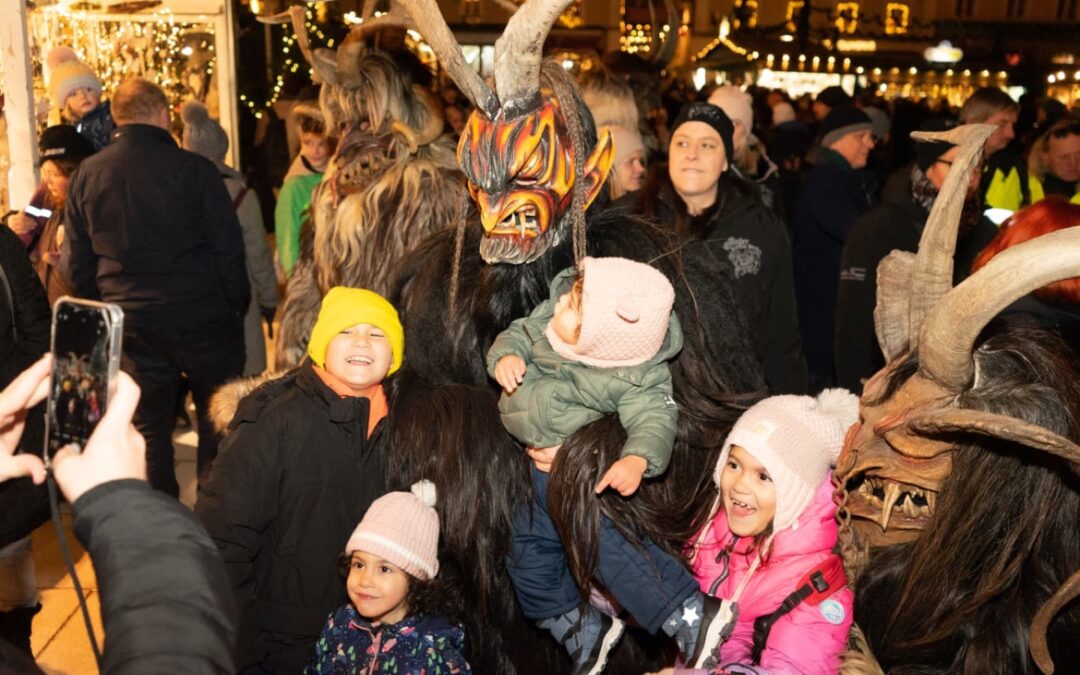
Fur, horns, bells, a carved mask: if you meet a figure like this in Salzburg in December, you’ll probably wonder whether it’s a Krampus – a horned, fur-clad figure from Alpine folklore who accompanies St. Nicholas – or one of the Perchten (fur-clad, masked figures from Alpine winter folklore). On 2 December 2026, Krampus figures come to us at the Salzburg Christmas market at Mirabellplatz together with St. Nicholas, and by then at the latest the question of Krampus vs Perchten comes up. The short answer: you often can’t tell the difference between Krampus and Perchten by their looks, but you can by the calendar.
What is the difference between Krampus and Perchten? Krampus accompanies St. Nicholas in Advent, around 5 and 6 December. Perchten are separate figures of the Rauhnächte (the “rough nights” between the winter solstice and Epiphany), from 21 December to Epiphany, appearing as beautiful and as “schiache” (ugly) Perchten.
When St. Nicholas and Krampus come to visit us is further down.
Krampus vs Perchten at a glance
Krampus and Perchten belong to two different customs. Krampus is tied to St. Nicholas and comes in Advent. Perchten belong to the Rauhnächte between the winter solstice and Epiphany. Here’s how to keep track:
| Krampus | Percht | |
|---|---|---|
| Occasion | St. Nicholas custom | Rauhnächte |
| When | in Advent, especially around 5 and 6 December | from 21 December to 6 January |
| Company | comes with St. Nicholas | without St. Nicholas, in their own groups |
| Figures | Krampus with chain and birch rod | Schönperchten and Schiachperchten |
| In Salzburg, for example | St. Nicholas and Krampus at Mirabellplatz | Perchten run at Domplatz, Pongauer Perchtenlauf |
According to Salzburg24, the Salzburg state association of folk-heritage clubs (Salzburger Landesverband der Heimatvereine) recommends keeping to the Perchten season from 21 December to 6 January and keeping the two customs separate. The Altgnigler from Salzburg, who keep up both traditions as the Altgnigler Krampus- und Perchtenpass, say on their website that they go out as Krampus figures until 8 December and only appear as Schiachperchten in the Rauhnächte.
Who is Krampus?
Krampus is the wild companion of St. Nicholas. He wears fur, horns, a mask, a chain and a birch rod. His big moment is the Krampusnacht (Krampus Night, 5 December), the eve of St. Nicholas’ Day.
According to the Altgnigler, his roots lie in the St. Nicholas plays of the 16th to 19th centuries, in which the devil was bound to St. Nicholas. From the 18th century onwards, pictures document house visits by St. Nicholas and Krampus in the towns. Where the name comes from isn’t certain. One explanation traces it back to “Krampen”, meaning claw, another to the Bavarian “Krampn”, meaning something withered.
Today, Krampus figures roam through towns and villages in groups, known as Krampus groups (Passen), often with bells and torches. When and where Krampus figures are out and about in the city of Salzburg in 2026 is in our article on Krampus in Salzburg.
What are Perchten? Schönperchten and Schiachperchten
Perchten are figures of the Rauhnächte, the nights between 21 December and Epiphany. According to folklore studies, their name comes from “Perchtag”, an old word for Epiphany on 6 January. In Salzburg, people distinguish between two groups:
- Schönperchten (“beautiful” Perchten) stand for good. They wear elaborate headdresses and move through towns and villages to bring good luck for the new year.
- Schiachperchten (“ugly” Perchten) stand for evil. They wear fur and hand-carved masks with horns and are meant to drive away the winter with their bells.
In Salzburg, the Schönperchten also include the Tresterer, Percht dancers in the Pinzgau region, and the Glöckler, who go about with bells and illuminated headdresses, in the Salzkammergut (lake district east of Salzburg) – although experts disagree about the Glöckler. The “Perchten” in Gastein have been on Austria’s national inventory of intangible cultural heritage since 2011. According to Salzburg Tourism, there are around 200 Passen in Salzburg.
Horns, masks, fur: how to tell them apart
By looks alone, you often can’t be sure whether you’re facing a Krampus or a Percht. Both wear fur, horns and carved masks, and every group designs its figures a little differently. The Altgnigler’s Schiachperchten, for example, wear six horns.
Three questions are more reliable:
- What’s the date? Before 6 December it’s usually a Krampus, from 21 December a Percht.
- Is St. Nicholas with them? Then it’s a Krampus.
- Are there also beautiful figures with large headdresses? Then you’re at a Perchten run (Perchtenlauf).
Why Krampus and Perchten are so often confused
There are simple reasons why the two customs often get mixed up. Many clubs keep up both, like the Altgnigler, and many runs have “Krampus- und Perchtenlauf” (Krampus and Perchten run) in their name. According to the Altgnigler, new Krampus and Schiachperchten groups have only existed since around 1900. The strict timing rules – Krampus until 6 December and Perchten only in the Rauhnächte – were therefore only set by some tradition keepers and Perchten runners between the 1930s and the 1980s.
The origins are also less clear-cut than is often claimed. Many sources call Krampus and Perchten “pagan” or “pre-Christian”. That’s disputed. According to the Salzburg State Institute for Folklore (Salzburger Landesinstitut für Volkskunde), the goddess Perchta, to whom the Perchten are often traced back, is an invention of the linguist Jacob Grimm. The St. Nicholas plays, on the other hand, are better documented as the roots of Krampus.
Where to see Krampus and Perchten in Salzburg
Here with us at Mirabellplatz, St. Nicholas and Krampus stop by on Wednesday 2 December 2026 at 6 pm, performed by the Altgnigler. Before that, at 5.15 pm, the Weisenbläser of Postmusik Salzburg play, wind players performing traditional Alpine melodies. So these are Krampus figures, not Perchten, just as the calendar says.
Christmas programme
On 2 December 2026 at 6 pm, St. Nicholas and Krampus come to visit us at Mirabellplatz. You’ll find all the dates of our Advent programme here.
You can see Perchten in the city on the first of the Rauhnächte, for example: according to the organiser of the Christkindlmarkt – the Austrian name for a traditional Christmas market – a Perchten run is scheduled at Domplatz for Monday 21 December 2026, provisionally at 7 pm (as of October 2026). It’s about a quarter of an hour’s walk there from Mirabellplatz, so you can drop in at our market beforehand. Our article on Krampus in Salzburg collects more Krampus runs in the city, and our article Christmas markets in Salzburg gives you an overview of all the markets in the city.
Frequently asked questions
No. Krampus belongs to the St. Nicholas custom in Advent, while Perchten belong to the Rauhnächte between 21 December and 6 January. Often, though, the same club keeps up both customs, which is why the figures sometimes look alike.
Krampus comes in Advent, especially around 5 and 6 December. Perchten traditionally go out in the Rauhnächte from 21 December to Epiphany on 6 January. Today, though, there are Perchten runs earlier in December too.
Schönperchten stand for good and wear elaborate headdresses. Schiachperchten, the “ugly” Perchten, stand for evil and wear fur, horns and carved masks. Both belong to the Rauhnächte.
Schiachperchten do. The Altgnigler’s Schiachperchten, for example, wear six horns. Schönperchten, on the other hand, are easy to recognise by their large, decorated headdresses.
That’s disputed. Many sources call Perchten pre-Christian, but there’s no evidence for it. According to the Salzburg State Institute for Folklore, the goddess Perchta is an invention of Jacob Grimm, and the name “Percht” comes from Perchtag, meaning Epiphany.
Krampus. On Wednesday 2 December 2026, St. Nicholas and Krampus come to visit us at Mirabellplatz at 6 pm. All dates are in the programme.
Sources
Retrieved on 26 October 2026: Salzburg Tourism: Krampus and Perchten · Salzburg24: Perchten in Salzburg, differences, history and myths (12/12/2024) · Altgnigler Krampus- und Perchtenpass, website (club, customs) · Austrian Commission for UNESCO: Perchten in Gastein · Wikipedia: Krampus, Percht · Organiser of the Salzburg Christkindlmarkt (date of the Perchten run on 21/12/2026)