
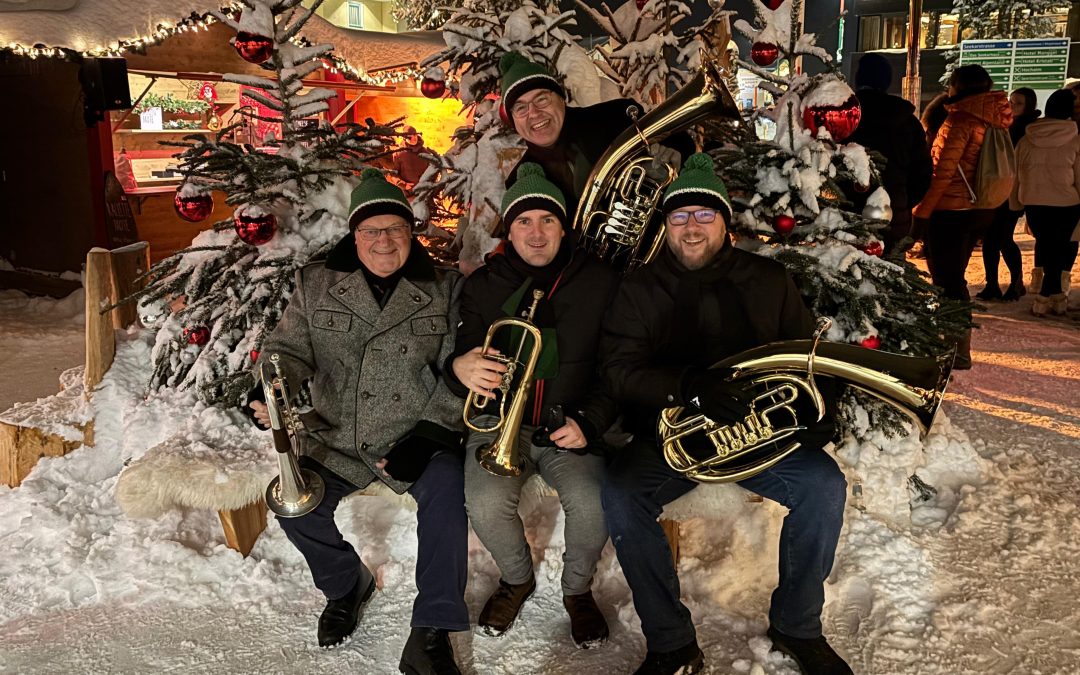
Wednesday 2 December 2026, 5.15 pm in front of Schloss Mirabell (Mirabell Palace): the Weisenbläser – wind players performing traditional Alpine melodies – of Postmusik Salzburg, a wind orchestra from Salzburg, play for the first time this Advent at our Salzburg Christmas market at Mirabellplatz (Mirabell Square), and two more dates follow. Here’s what we know about them, what Weisenblasen (playing Weisen, traditional Alpine melodies, on wind instruments) is and what links Postmusik to Mirabell Gardens next door.
What are the Weisenbläser of Postmusik Salzburg? The Weisenbläser of Postmusik Salzburg are a wind ensemble drawn from the ranks of Postmusik Salzburg, led by Josef Harl. They play Alpine Weisen, well-known Christmas songs and festive pieces. Their tradition has its origins in the Christmas wind music (Weihnachtsblasen) played at post offices.
All the dates for our Advent music are further down.
The Weisenbläser of Postmusik Salzburg in Advent 2026
In 2026 the Weisenbläser play in front of Schloss Mirabell on three days (as of our programme of 2 November 2026):
| Date | What’s on that day |
|---|---|
| Wed 2 Dec 2026, 5.15 pm | Advent Wednesday, the day before the Krampus run with St. Nicholas |
| Wed 16 Dec 2026, 5.15 pm | a Wednesday in Advent |
| Sun 27 Dec 2026, 3.30 pm | between the holidays, already in the afternoon |
St. Nicholas and Krampus – a horned, fur-clad figure from Alpine folklore who accompanies St. Nicholas – come the day after: on Thursday 3 December 2026, from 6 pm, it’s the Krampus run with St. Nicholas. The Krampusse of the Alt Gnigler Krampus Perchten Pass make their way across the market, and St. Nicholas hands out sweets to the children. What Krampus is all about is in Krampus in Salzburg 2026. The date on 27 December is after Christmas, and our market is open until 31 December. What else is on in the city during those days is in Salzburg Christmas markets after Christmas.
What is Weisenblasen?
Weisenblasen means playing Weisen on wind instruments. According to the Digitales Wörterbuch der deutschen Sprache (DWDS), a dictionary of the German language, a Weise is a melody, a smaller piece of music. Even in Old High German, “wīsa” stood for melody.
In Alpine folk music, the flugelhorn is a typical melody instrument, while the tenor horn plays secondary parts and countermelodies. Both are used in Weisenblasen, according to the Wikipedia list of folk music instruments.
We haven’t found any information on the instruments and size of the Postmusik’s Weisenbläser. Our home page describes their repertoire: it ranges from traditional Alpine Weisen and well-known Christmas songs to modern festive pieces.
What we know about the Weisenbläser
Little has been published about the ensemble itself. This is what we know for certain:
- Origins: Their musical tradition has its origins in the Christmas wind music played at post offices (home page).
- Leader: Josef Harl (programme 2026).
- In Advent: They can be heard again and again at various markets during Advent (home page).
- With us: They’re in the 2024 and 2025 programmes of the Advent music in front of Schloss Mirabell and play three times again in 2026.
When the Weisenbläser were founded and how the Christmas wind music at the post offices worked back then, we haven’t found published anywhere. If we learn more, we’ll add it here.
Postmusik Salzburg: from Postschutzkapelle to wind orchestra
Postmusik Salzburg is the band behind the Weisenbläser, and its own chronicle tells quite a lot about it. All the following details come from postmusik-salzburg.at (retrieved on 2 November 2026):
- 1938: In the autumn, the band was founded as the “Postschutzkapelle Salzburg”.
- After the war: Under its present name, Postmusik Salzburg, the orchestra became part of the Gewerkschaft der Post- und Telegraphenbediensteten (postal and telegraph workers’ union), Salzburg regional group.
- 1983: The musicians received the historical uniform of a prince-archbishop’s postilion from around 1780. It still shapes the look of Postmusik today.
- 2007: The CD “Sound of Music” earned a gold CD.
Today, according to its own website, Postmusik is a symphonic wind orchestra of amateurs and professionals. Concert tours have taken it to Australia, Tasmania and China, among other places, and it plays regularly in the context of the Salzburg Festival. Besides the large orchestra there are smaller ensembles, such as the Post Big Band Salzburg (since 2003), the Post-Böhmische Salzburg, newly formed in 2025, and a quartet. Its calendar lists a wind quartet of Postmusik on the Friedenslicht (Peace Light) train of the Salzburger Lokalbahn on 24 December 2026.
Which filming locations of The Sound of Music you can find around Mirabellplatz in winter too is in The Sound of Music in Salzburg in winter.
In the gardens in summer, in front of the palace in Advent
Postmusik Salzburg has been playing in Mirabell Gardens for 70 years. According to its chronicle, it first took part in a Mirabell Gardens concert in 1956, and since then many promenade concerts and illuminated-fountain concerts (Leuchtbrunnenkonzerte) have been on its programme every summer. In summer 2026, according to its website, illuminated-fountain concerts in Mirabell Gardens were on the programme on 17 June and on 5 and 19 August.
In Advent, the Weisenbläser play a few steps further on, in front of Schloss Mirabell at our market. What the gardens look like in winter and what’s open there is in Mirabell Gardens in winter.
Christmas programme
In 2026 the Weisenbläser and six other ensembles play in front of Schloss Mirabell on 20 days, plus the lighting of the Christmas tree and the Krampus run with St. Nicholas. It’s all in our programme.
Who else plays in front of the palace
Seven ensembles play at our Advent music in 2026. We’ve sorted who plays when by ensemble in Advent music at Mirabellplatz: the wind ensembles. The Bürmooser Blechbläser, a brass ensemble whose tradition goes back to the years between the wars, have a portrait of their own too. And how to combine Advent music with Turmblasen (brass music played from the city’s towers) in the Old Town in one evening is in Turmblasen and Advent music in Salzburg.
Frequently asked questions
On Wednesday 2 December and Wednesday 16 December 2026, each time at 5.15 pm, and on Sunday 27 December at 3.30 pm. They play in front of Schloss Mirabell, right in the middle of our Christmas market.
Weisenbläser play Weisen, that is, melodies and smaller pieces of music, on wind instruments. In Alpine folk music these are mainly the flugelhorn and the tenor horn. According to our home page, the Weisenbläser of Postmusik play Alpine Weisen, Christmas songs and festive pieces.
From the ranks of Postmusik Salzburg. Their tradition has its origins in the Christmas wind music played at post offices. We haven’t found the ensemble’s founding year or line-up published anywhere.
Since autumn 1938. According to its chronicle, it was founded as the “Postschutzkapelle Salzburg” and got its present name, Postmusik Salzburg, after the Second World War.
According to its chronicle, Postmusik first played at a Mirabell Gardens concert in 1956. Since then, promenade concerts and illuminated-fountain concerts have been on its programme every summer, in 2026 for example illuminated-fountain concerts in Mirabell Gardens in June and August.
Not on the same evening. St. Nicholas and the Krampusse come the day after the Weisenbläser’s first date: on Thursday 3 December 2026, from 6 pm, it’s the Krampus run with St. Nicholas, and St. Nicholas hands out sweets to the children. Entry is free.
Sources
Retrieved on 2 November 2026: Christmas market at Mirabellplatz: programme 2026 · home page of the Christmas market at Mirabellplatz (ensemble text) · Postmusik Salzburg (home page with dates, chronicle, about us, other ensembles, post “Sommer, Sonne … Postmusik” of 8 June 2026) · DWDS: Weise · Wikipedia: list of folk music instruments · programmes “Adventmusik vor dem Schloss Mirabell” (Advent music in front of Schloss Mirabell) 2024 and 2025