
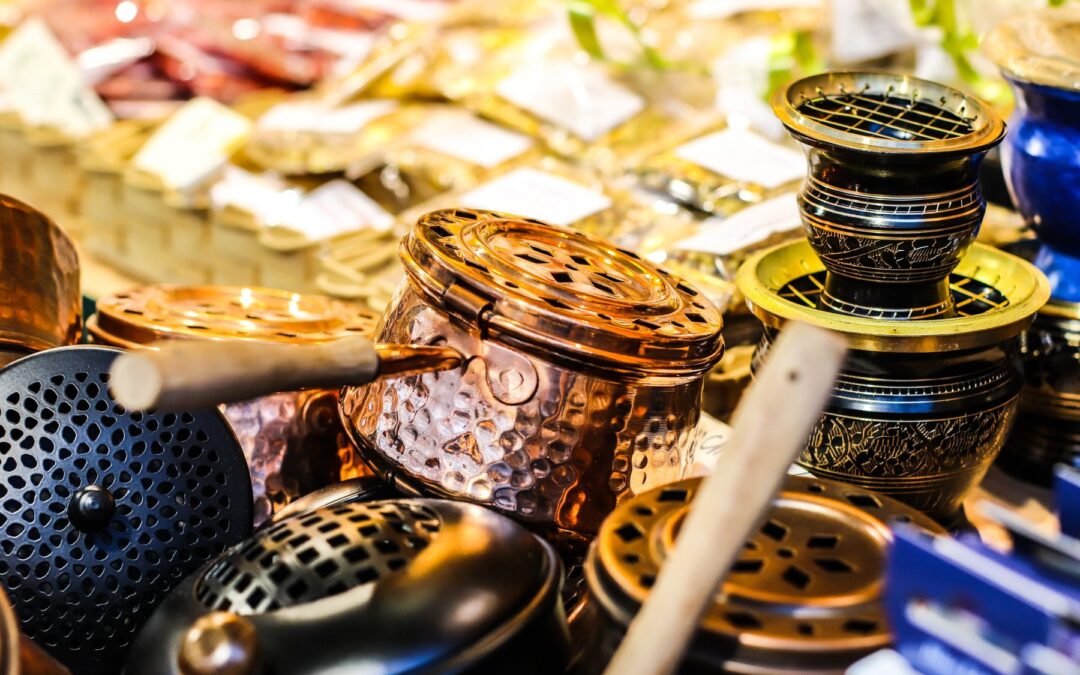
On the evening of 24 December, frankincense drifts through the living room in many Salzburg homes: someone carries a pan full of embers from room to room, often all the way down to the cellar. This is burning incense in the Rauhnächte (the “rough nights” between the winter solstice and Epiphany), a household tradition documented since the Middle Ages. Here you’ll find out when the Rauhnächte are in 2026, how they’re counted in Salzburg and where to get frankincense with us at Mirabellplatz.
What are the Rauhnächte? The Rauhnächte (also spelled Raunächte) are the twelve nights between Christmas and Epiphany; in some regions they start as early as St. Thomas’s Day on 21 December. According to the University of Innsbruck, the name comes from smoking out the house with incense. In Salzburg, incense is burned above all on Christmas Eve, on New Year’s Eve and on the night before Epiphany.
Where to find incense at our market is further down.
When are the Rauhnächte in 2026?
Depending on how you count them, the Rauhnächte 2026/27 begin on Monday 21 December 2026 or on Thursday 24 December 2026, and end with Epiphany (Three Kings’ Day) on Wednesday 6 January 2027. The most important nights for burning incense:
| Night | Date | Day of the week |
|---|---|---|
| Thomasnacht (St. Thomas’s Night, 21 December; regional) | 21 December 2026 | Monday |
| Christmas Eve, Christmas Night | 24 December 2026 | Thursday |
| New Year’s Eve | 31 December 2026 | Thursday |
| Night before Epiphany (Perchtnacht) | 5 January 2027 | Tuesday |
| Epiphany, end of the Rauhnächte | 6 January 2027 | Wednesday |
If you count twelve nights, you count from Christmas to Epiphany. Exactly where the count begins varies from region to region.
Twelve nights or four: how Salzburg counts them
Today people usually talk about twelve Rauhnächte. The Salzburger Landesinstitut für Volkskunde (Salzburg Institute of Folklore), on the other hand, names four historic Rauchnächte (literally “smoke nights”): Christmas Eve, New Year’s Eve, the night before Epiphany and, in some regions, the Thomasnacht on 21 December. Depending on the region, according to the institute, people counted up to twelve nights between 21 December and 6 January.
Even within the province of Salzburg, it isn’t uniform. According to SalzburgerLand Tourism, many families burn incense mainly on the nights of Christmas, New Year’s Eve and 5 January, and some from as early as 21 December. In the Saalach valley (Saalachtal), for example on a farm in Unken, people speak of three Rauchnächte, according to Saalachtal Tourism: Christmas Eve, New Year’s Eve and Epiphany.
How the Rauhnächte fit in with the other traditions in Advent and around Christmas is shown in our overview of Christmas traditions in Austria.
Burning incense in the Rauhnächte: how the tradition works
Burning incense, sometimes called smoke cleansing, means placing frankincense, resin or dried herbs on embers and carrying the smoke through every room. According to the Institute of Folklore, people use a “Gluat- or Rachpfandl” (a small ember pan) or another fireproof vessel. The incense is carried through the living rooms, the cellar and the attic, and on farms also the cowshed. Holy water is sprinkled with a palm or fir branch, and sometimes people pray.
The herbs often come from the Kräuterbuschen, a bundle of herbs blessed in church on 15 August, the Feast of the Assumption. To stay safe: never leave embers unattended, place the vessel on a fireproof surface and air the room well afterwards.
Frankincense and incense from Mirabellplatz
With us, you’ll find frankincense in Alexandra Wirnsberger’s incense hut. She has pure frankincense from Oman and Somalia, on its own or mixed with herbs, plus incense sticks and incense cones, scented oils and suitable burners. New in 2026 are incense sticks and cones made with Swiss stone pine (Zirbe). “Burning incense and cleansing are part of Christmas,” Alexandra Wirnsberger wrote to us in our questionnaire.
The hut has been at our market for almost 30 years. All year round, Alexandra Wirnsberger has her stall on Thursdays at the Schranne (the weekly Thursday market at Mirabellplatz), held around St. Andrew’s Church (Andräkirche). It’s best to ask for incense there. What else you can take home from our market is in our article on gifts from the Christmas market.
Our exhibitors
Frankincense, incense cones and incense sticks are available in Alexandra Wirnsberger’s incense hut. You’ll find all our huts in our exhibitor overview.
In 2026 our market is open until 31 December, and on Christmas Eve from 10 am to 3 pm. All opening hours are on our page Opening hours and directions.
Perchten in the Rauhnächte
In Salzburg, the Rauhnächte also belong to the Perchten (fur-clad, masked figures from Alpine winter folklore), who wear bells and are meant to drive out the winter. There’s a big Perchten run in the city on Monday 21 December 2026 for the first Rauhnacht, on Domplatz; according to the organiser of the Christkindlmarkt – the Austrian name for a traditional Christmas market – it’s expected to start at 7 pm (as of 28 October 2026).
What makes Perchten different from Krampus – a horned, fur-clad figure from Alpine folklore who accompanies St. Nicholas – and why some of them are beautiful and others “schiach”, that is, ugly, is explained in Krampus or Percht?. The Krampus runs in Advent are in our article on Krampus in Salzburg.
Wishes and fortune-telling: what is old tradition
Besides burning incense, the Rauhnächte used to include Losen (fortune-telling for the coming year): people tried to read signs that would tell them something about the year ahead. The University of Innsbruck describes this as “Leaslen” in the Tyrolean Unterland, probably from the 19th century onwards.
Online today you’ll often read about a wishes ritual with thirteen slips of paper, or about a special meaning for each night. Neither appears in the descriptions by the University of Innsbruck or the Salzburg Institute of Folklore. What’s well documented in Salzburg is above all burning incense and the Perchten.
Frequently asked questions
Depending on how you count, from Monday 21 December 2026 or Thursday 24 December 2026 until Epiphany on Wednesday 6 January 2027. In Salzburg, incense is burned above all on 24 and 31 December and on 5 January.
Today most people count twelve. In Salzburg, the Institute of Folklore speaks of four historic Rauchnächte: Christmas Eve, New Year’s Eve, the night before Epiphany and, in some regions, the Thomasnacht on 21 December.
According to the University of Innsbruck, the name comes from smoking out the house with incense, which is why in Salzburg they’re often called Rauchnächte too.
A fireproof vessel with embers, such as a small ember pan, plus frankincense, resin or dried herbs. Never leave embers unattended, and air the room well afterwards.
With us at the Christmas market at Mirabellplatz, in Alexandra Wirnsberger’s incense hut. All year round she has her stall on Thursdays at the Schranne at Mirabellplatz; it’s best to ask for incense there.
In the city, at the Perchten run on Domplatz on 21 December 2026, according to the organiser expected at 7 pm (as of 28 October 2026).
Sources
Retrieved on 28 October 2026: University of Innsbruck, database of festivals and customs (Feste und Bräuche), entry “Rauhnacht” · Salzburg24, “Wundersame Raunächte um die Weihnachtszeit” (Wondrous Raunächte around Christmas), with Ulrike Kammerhofer-Aggermann and Michael Greger, Salzburger Landesinstitut für Volkskunde (22 December 2015) · SalzburgerLand Tourism, magazine article “Rauhnächte” · Saalachtal Tourism (lofer.com), Rauchnächte · salzburg.info, Perchten run on Domplatz 2026 and the Schranne market · Organiser of the Salzburg Christkindlmarkt, programme 2026 · Exhibitor questionnaire Alexandra Wirnsberger (6 October 2026)