
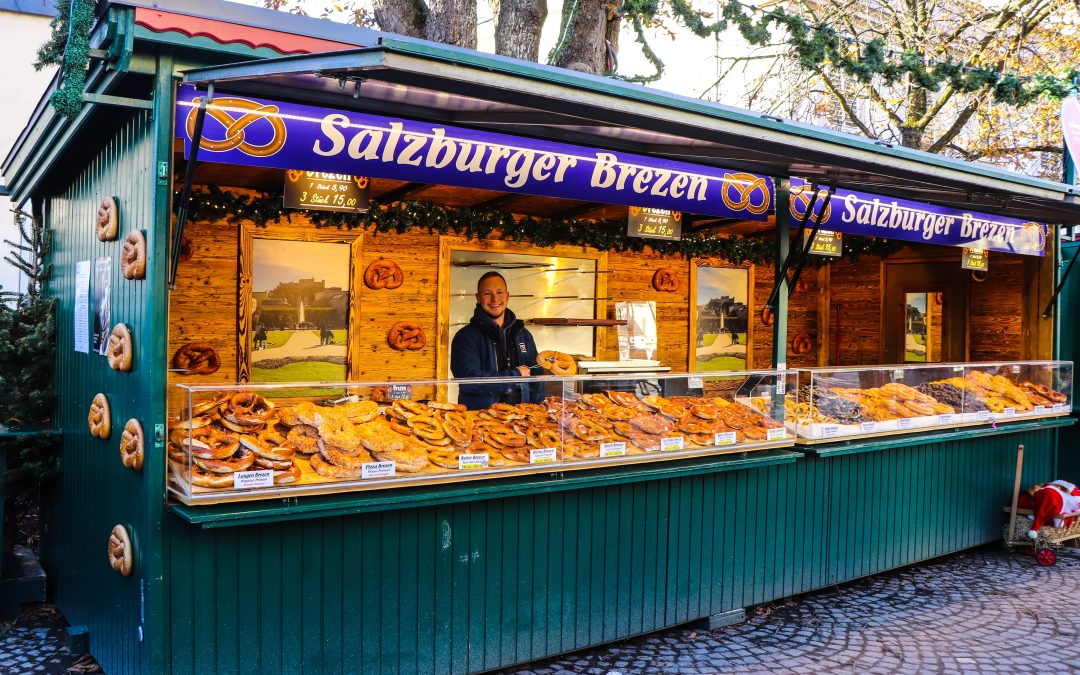
A lye pretzel with ham, next to it pretzels with cinnamon sugar and chocolate pretzels with a glaze: that’s what Alexander Reisinger’s display looked like at our Salzburg Christmas market at Mirabellplatz (Mirabell Square) in Advent 2025. Today his Salzburger Brezen (pretzels from Salzburg; also the name of Alexander Reisinger’s business) come in twelve varieties, handmade in Salzburg, and he started out in 1996 with a pretzel stand on Universitätsplatz. Here we tell you where the pretzel comes from and what’s behind these Salzburg pretzels and their hut.
What are Salzburger Brezen? Salzburger Brezen is Alexander Reisinger’s business, Salzburger Brezen GmbH. He has been selling handmade pretzels in Salzburg since 1996, today in twelve varieties, and in Advent also in his hut at the Christmas market at Mirabellplatz. “Breze” or “Brezen” is what people in Bavaria and Austria call the Brezel, the soft pretzel.
You’ll find all the huts at our market further down.
Breze, Brezen, Brezel, pretzel: one bake, several names
Breze, Brezen and Brezel all mean the same bake: the pretzel. According to the Duden dictionary, “die Breze” and “die Brezen” are Bavarian and Austrian, and the plural of both is “die Brezen”. You’ll often see “Brezn” too; that’s how the Austrian Ministry of Agriculture spells it in its register of traditional foods, for example.
The name is old. The Duden traces it via Middle High German “brēzel” and Old High German “brezitella”, probably back to the Latin “brachium”, the forearm. The shape of the pretzel is reminiscent of intertwined arms.
Where does the pretzel come from?
Nobody knows exactly. In its register (number 221, “Laugenbrezel, Laugengebäck”, lye pretzels and other lye bakes), the ministry names these traces:
- The first picture of a pretzel is in the “Hortus Deliciarum” from the 12th century, an illustrated manuscript by the nun Herrad of Landsberg from Hohenburg Abbey in Alsace.
- The origin probably lies in a Roman ring bread. In the Middle Ages the pretzel was widespread in monasteries as a Lenten bake; its shape was meant to show arms crossed in prayer.
- The shape at first had only one arm, similar to the number six. Today’s pretzel came about when two of these one-armed pretzels were joined together.
- Baking: the Brezn used to be baked only in the 40 days before Easter. Unlike many other traditional festive bakes, it always came from the baker and never from home baking.
Perhaps that’s why the pretzel has been the emblem on the bakers’ coat of arms since the beginning of the 14th century, as it still is today.
There are several stories about the lye pretzel. One tells of a baker in Urach who is said to have been pardoned in 1477 because he invented a bake through which the sun shines three times. Another tells of a Munich baker who in 1839 is said to have brushed his pretzels with lye by mistake instead of sugar water. The ministry lists both among the “numerous stories” about how the lye pretzel was invented.
Lye pretzel or sweet pretzel: what’s the difference?
A lye pretzel (Laugenbreze) is dipped briefly in diluted lye (sodium hydroxide) before baking. According to the Austrian Food Codex (Österreichisches Lebensmittelbuch), a 2 to 6 per cent solution is usual. During baking the lye is neutralised, leaving the thin, chestnut-brown, glossy crust with the typical lye flavour.
There are differences in the shaping, too. For the Bavarian pretzel the baker rolls the strand of dough evenly thick; for the Swabian one, thicker in the middle, with a “belly” that is slit lengthways before baking. The pretzel is looped with the “Brezenwurf” (the swing of the dough that twists the two ends and lays them in place).
But a pretzel doesn’t have to be made with lye. The Duden describes the Brezel as a salty bake dipped in lye “or a sweet” one. Alexander Reisinger describes his pretzels the same way: “From sweet to sour!”
Salzburger Brezen: how Alexander Reisinger started in 1996
The story of Salzburger Brezen begins on Universitätsplatz in Salzburg’s old town. On his website, Alexander Reisinger writes:
“In May 1996, after months of thinking it over, I decided to open a Brezen stand on Salzburg’s Universitätsplatz!”
In July 1996 he opened a pretzel and ice-cream stand there, “in a somewhat rustic way”, as he puts it. After that he travelled to markets in the surrounding area, bought a sales trailer so that he wouldn’t depend so much on the weather, and took on his first staff. Today the business has its own fleet of sales trailers.
The pretzels are “genuinely handmade”. They’re baked fresh every day by a baker who starts work earlier specially for them, and then taken straight to the stands. According to the business, the pretzels travel to “all the larger events throughout Austria”: to Kirtag (traditional village fair) celebrations and to folk, lake, village and town festivals, and also to Bavaria and Italy. Incidentally, the sources don’t describe a distinct Salzburg pretzel shape: the name stands for the business and its city.
Two huts at Mirabellplatz: pretzels, Glühwein, sausages
Alexander Reisinger has been with us at Mirabellplatz in Advent for more than 25 years, today with two huts:
- In the pretzel hut you’ll find Salzburger Brezen in twelve varieties.
- In the drinks hut there’s Glühwein (hot mulled wine, spiced with cinnamon, cloves and orange) and Glühmost (hot spiced cider), orange punch and Kinderpunsch (alcohol-free punch for children), coffee and hot sausages.
New this year, according to the business, is “a newly decorated Christmas hut”. What makes Glühwein, Glühmost and Punsch different is explained in our article Glühwein, Glühmost, Punsch, Kinderpunsch: what’s the difference?. What else there is to eat with us, from Bauernkrapfen (traditional fried dough pastries) to Kaspressknödel (fried cheese dumplings), is in our guide to food at the Christmas market.
So which pretzel will you go for? The tip from the hut: “Best to try every kind of Brezen, because each one is better than the last.”
Our exhibitors
Alexander Reisinger has two huts with us at Mirabellplatz. You’ll find all our exhibitors and their stories in our exhibitor overview.
There’s more about the two huts, with photos, on Alexander Reisinger’s page in our exhibitor overview. You’ll find the business’s website at brezen.com.
One more look at other huts at our market: if you come into town straight from a day on the slopes, you can have a go on the Shotski (a ski with several shot glasses mounted on it) at Apres Allstars; more on that in Après-ski in the middle of Salzburg. And if you’re still looking for a small gift for your skiing friends, you’ll find ideas from several huts in Gifts for skiers.
Frequently asked questions
Salzburger Brezen is Alexander Reisinger’s business, Salzburger Brezen GmbH. He has been selling handmade pretzels since 1996, today in twelve varieties: on Universitätsplatz, at festivals and, in Advent, with us at Mirabellplatz.
Twelve, according to the questionnaire the business sent us in October 2026. In our photos from Advent 2025, the display includes lye pretzels with ham, pretzels with cinnamon sugar and chocolate pretzels.
At the Salzburger Brezen stand on Universitätsplatz, right next to the Universitätskirche (University Church). The business also travels to Kirtag fairs and festivals throughout Austria, in Bavaria and in Italy.
All of them are correct. According to the Duden, “Breze” and “Brezen” are Bavarian and Austrian, while “Brezel” is the general form. The plural of Breze is Brezen.
According to the Austrian Ministry of Agriculture’s register of traditional foods, the pretzel has been the emblem on the bakers’ coat of arms since the beginning of the 14th century. One reason could be that pretzels always came from the baker and were never baked at home.
With the Bavarian pretzel, the strand of dough is the same thickness all the way along. The Swabian one is thicker in the middle and slit there before baking, which leaves a pale stripe.
Sources
Retrieved on 30 October 2026: Salzburger Brezen website (history, company, products, markets) · exhibitor questionnaire from Salzburger Brezen (19 October 2026) · our exhibitor page for Alexander Reisinger with photos from Advent 2025 · Austrian Federal Ministry of Agriculture and Forestry, Climate and Environmental Protection, Regions and Water Management, Register of Traditional Foods no. 221 “Laugenbrezel, Laugengebäck” (citing the Austrian Food Codex, Codex chapter B18) · Duden online, entries “Brezel”, “Breze” and “Brezen” · information from Tobi Deckert (Apres Allstars), 30 October 2026 · our page Opening hours and directions